Strong case 91st PSNR percentile · 27.51 dB
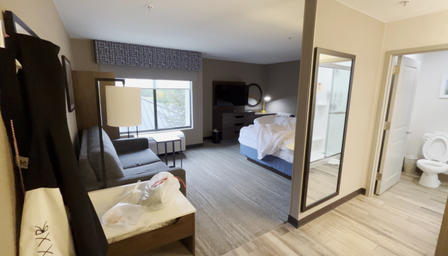
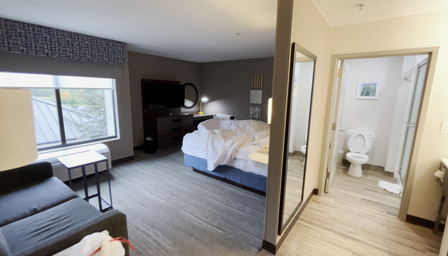
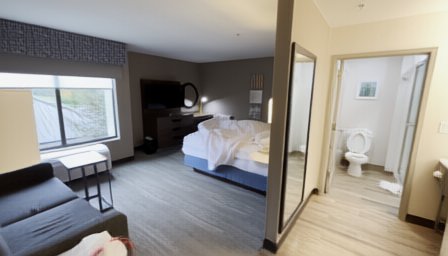
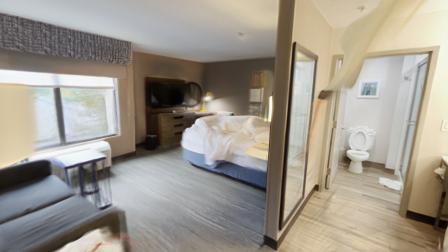
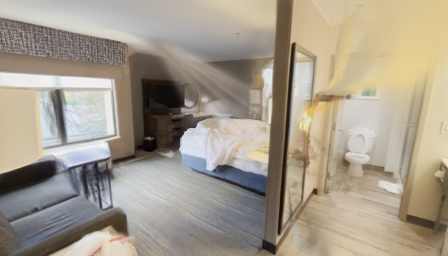
LVSPM preserves sharper doorway, window, and furniture detail. AnySplat retains the room layout but is softer, while DepthSplat shows pronounced geometric warping.
An evidence-first visual tour with synchronized LVSPM, AnySplat, and DepthSplat paths; canonical NVS results; all six DL3DV pose baselines; saved camera trajectories; measured inference speed; ablations; and an explicit failure case.
We rendered complete spline camera paths for all 135 scenes in the canonical DL3DV 64-view split, ranked them using scene-level PSNR, SSIM, and LPIPS, and then reviewed temporal continuity. These four top-eight scenes were chosen for both quality and visual diversity.
Every displayed frame is model-generated. Translation uses cubic interpolation and orientation uses rotation splines through held-out target cameras. Selection is performed per scene—never by choosing isolated frames. Complete 135-scene ranking.
Static targets can hide temporal instability. These videos render LVSPM, AnySplat, and DepthSplat along the exact same physical camera path: cubic translation and rotation splines through the same sorted held-out cameras. LVSPM is shown largest; method and pose-input labels are embedded in every frame.
We present LVSPM, a generalizable model that jointly estimates camera poses and synthesizes novel views from uncalibrated image collections. LVSPM unifies camera recovery and target-view image prediction as a sequence-to-sequence task: learnable camera tokens and image tokens pass through a long-context backbone, after which lightweight heads predict camera parameters and target RGB images. Trained with RGB images, poses, and intrinsics, the model avoids dense point-map or depth supervision. Test-time-training layers allow LVSPM to process hundreds of input views, including sequences longer than those seen during training. We evaluate pose estimation and novel-view synthesis on RealEstate10K, CO3Dv2, and DL3DV with 16 to 256 input views.
LVSPM represents a scene as a sequence of image and camera tokens. Local view attention exchanges information among nearby views, while large-chunk test-time-training updates carry information through long sequences.
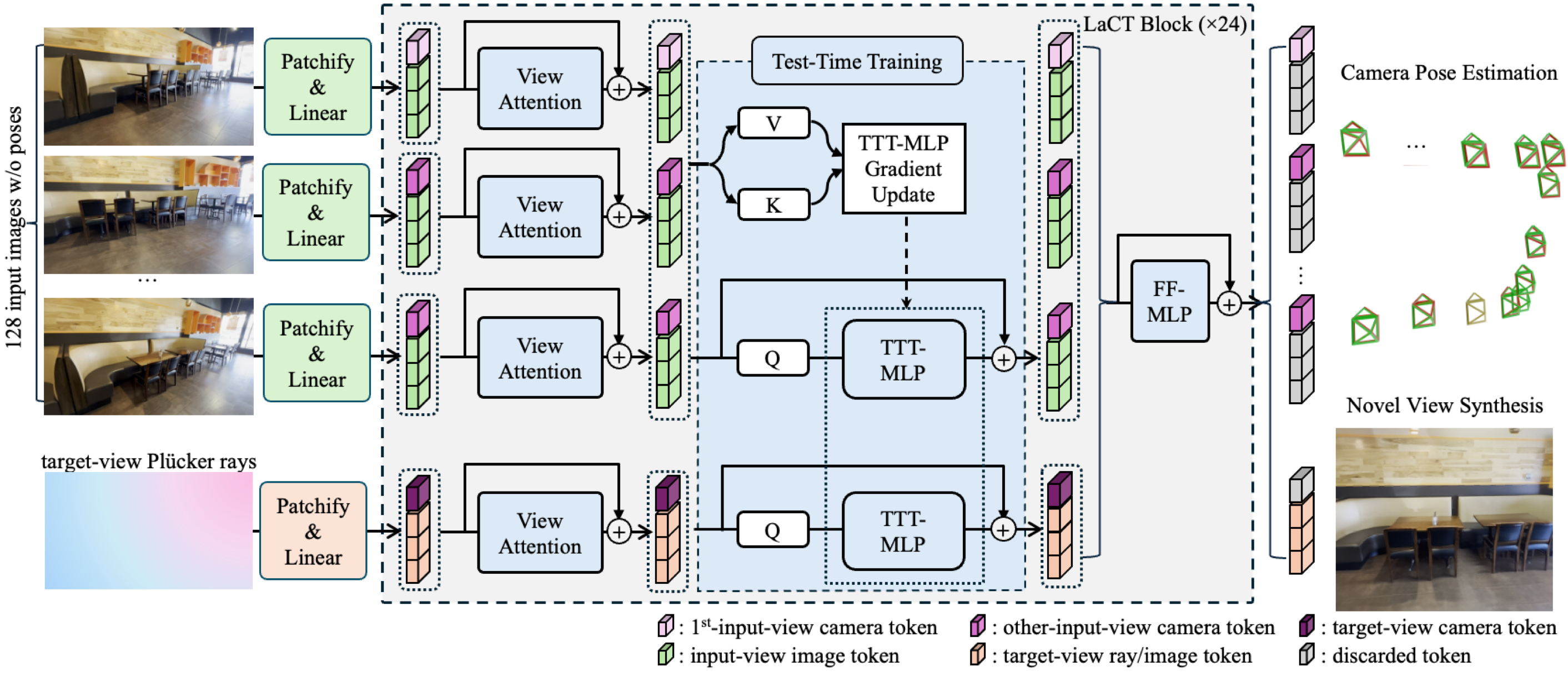
Joint prediction. Image synthesis and camera estimation train one backbone, allowing rendering supervision to provide a useful geometric signal.
Long context. TTT hidden-state updates extend the number of input views at inference without changing the architecture.
Accessible supervision. Training uses RGB, poses, and intrinsics rather than dense depth or point maps.
These examples were selected by scene-level PSNR rank over the complete 135-scene canonical DL3DV 64-view evaluation—not by selecting individual frames. Click an image to enlarge it.
LVSPM preserves sharper doorway, window, and furniture detail. AnySplat retains the room layout but is softer, while DepthSplat shows pronounced geometric warping.
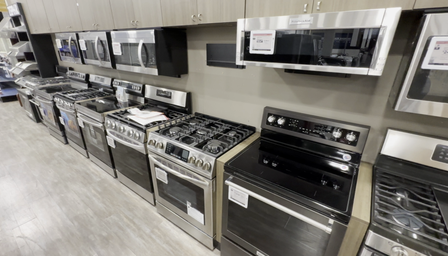
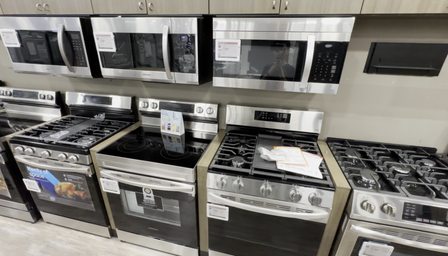
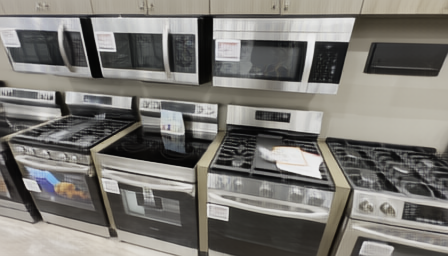
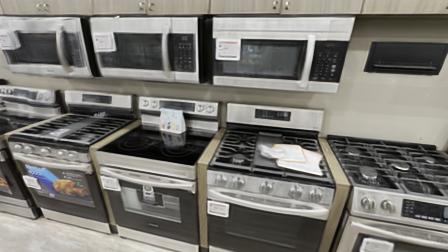
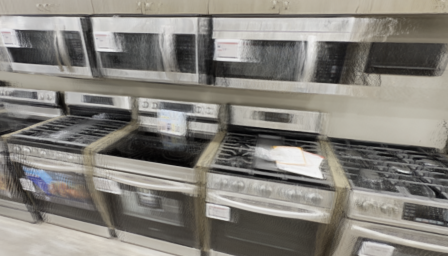
The median case retains the room layout and appliance edges while repeated fine structures remain challenging.
LVSPM images above are from a fresh cleaned-code rerun. Matched AnySplat and DepthSplat outputs are existing benchmark artifacts. Rerun details and hashes.
The equi-temporal protocol keeps sampling density approximately fixed while expanding temporal coverage, so larger input counts represent increasingly large scenes.
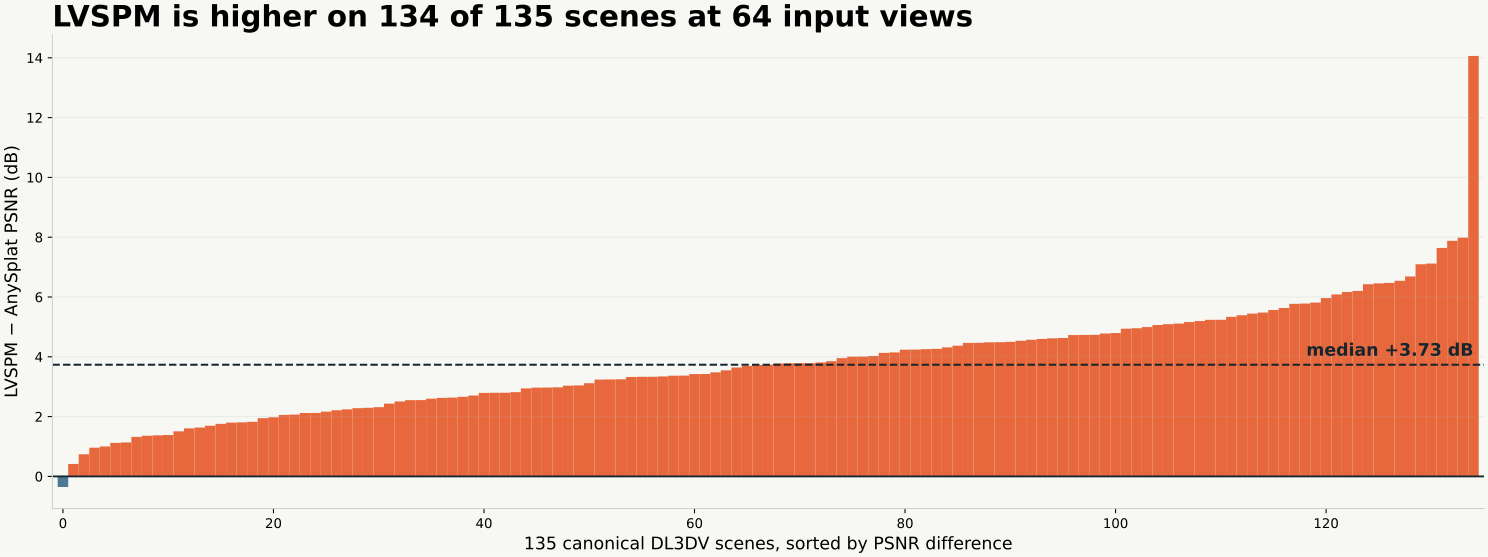
134 / 135higher PSNR
129 / 135higher SSIM
124 / 135lower LPIPS
+3.73 dBmedian PSNR difference
Direct scene-ID join between the complete LVSPM and AnySplat 64-view output trees. Five extra stored scenes are excluded from the canonical 135-scene count.
Same 135 canonical scenes for every reported cell
| Method | Metric | 16 | 64 | 128 | 256 |
|---|---|---|---|---|---|
| LVSPM | PSNR ↑ | 25.84 | 24.36 | 23.32 | 22.15 |
| LVSPM | SSIM ↑ | .815 | .757 | .714 | .661 |
| LVSPM | LPIPS ↓ | .150 | .180 | .206 | .244 |
| AnySplat | PSNR ↑ | 23.19 | 20.54 | 19.45 | 18.56 |
| AnySplat | SSIM ↑ | .759 | .647 | .597 | .548 |
| AnySplat | LPIPS ↓ | .157 | .247 | .293 | .338 |
| DepthSplat† | PSNR ↑ | 24.81 | 18.40 | OOM | OOM |
| DepthSplat† | SSIM ↑ | .849 | .618 | OOM | OOM |
| DepthSplat† | LPIPS ↓ | .133 | .362 | OOM | OOM |
†DepthSplat receives ground-truth camera poses; LVSPM and AnySplat are pose-free.
Relative pose AUC@3 ↑
| Fast3R | Cut3R | TTT3R | Flare | VGGT | DA3 | LVSPM |
|---|---|---|---|---|---|---|
| 8.0 | 19.2 | 36.5 | 71.1 | 83.6 | 83.8 | 90.1 |
AUC@3 requires relative rotation and translation errors to fall below the strict 3° threshold.
On the freshly rerun strong case, LVSPM reaches 93.8 AUC@3 over 64 input cameras. The displayed trajectories are similarity-aligned for visualization; the relative-pose metric itself does not depend on this alignment.
99.3 AUC@3096.1 AUC@593.8 AUC@3
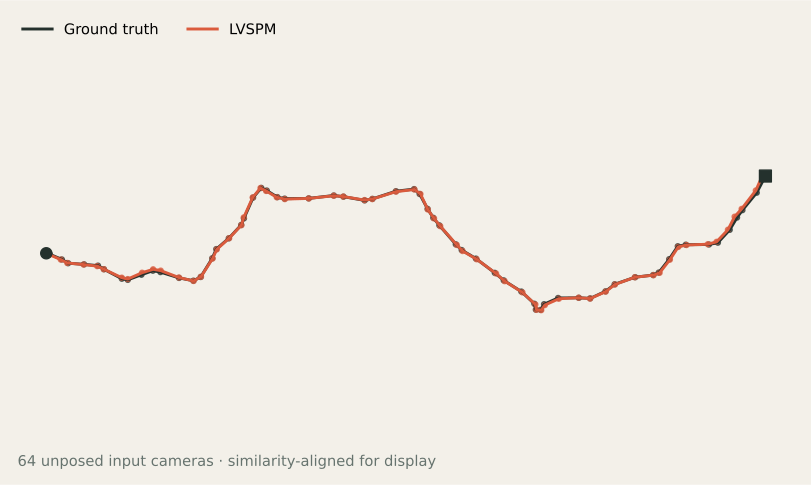
AUC@3 ↑ under the release evaluation protocol
| Dataset | 16 views | 32 views | 64 views | 128 views | 256 views |
|---|---|---|---|---|---|
| RealEstate10K | 40.0 | 50.3 | 58.2 | 61.3 | — |
| CO3Dv2 | 39.2 | 55.4 | 64.3 | 68.8 | — |
| DL3DV | 88.4 | 92.3 | 92.0 | 90.0 | 90.1 |
Release-authoritative values are shown. RealEstate10K and CO3Dv2 numbers supersede stale rows in the submission manuscript.
On the ASE ablation with 32 input and target views, removing RGB supervision reduces strict camera-pose accuracy from 71.9 to 50.9 AUC@3. This supports the joint formulation: learning to render provides useful geometric supervision.
H100 measurements reported in the paper at 512×288. Training used sequences up to 128 views; 256-view evaluation measures length generalization.
LVSPM uses multi-stage training and remains challenged by extreme lighting changes, minimally textured surfaces, reflections, and fine view-dependent structure. Geometry-specialized methods may remain preferable when precise reconstruction is the only objective.
@inproceedings{chen2026lvspm,
  title     = {LVSPM: Long Sequence View Synthesis and Pose Estimation Model},
  author    = {Chen, Xi and Zhang, Yachi and Chen, Linghao and Liu, Minghua
               and Su, Hao and Xu, Zexiang and Zhang, Xiaoshuai},
  booktitle = {European Conference on Computer Vision},
  year      = {2026}
}