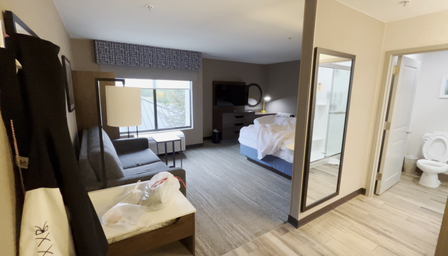
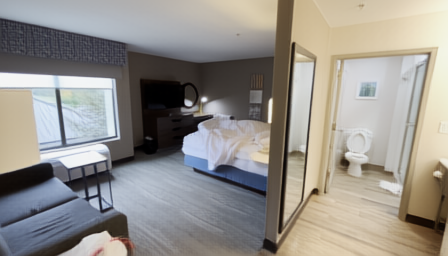
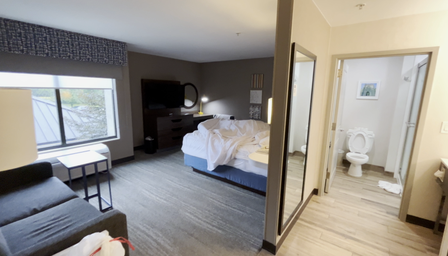
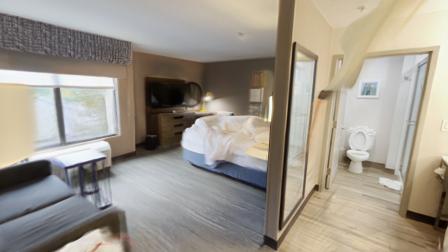
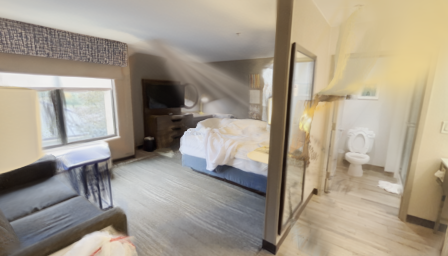
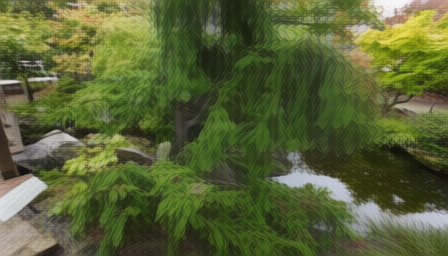
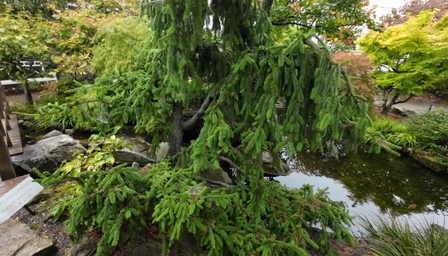
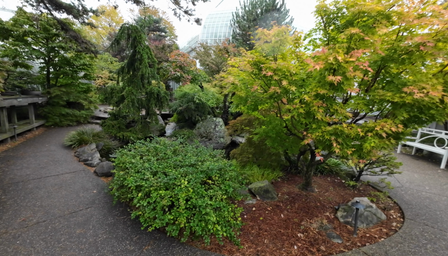
All three render the exact spline through the same sorted held-out cameras. AnySplat's path is mapped into its reconstructed Gaussian frame by one Sim(3) fitted from context cameras; DepthSplat receives ground-truth context poses.
The camera motion is synchronized by normalized spline position, not by cherry-picked frames. The complete round trip is shown, with method and pose-input labels embedded in the video.
POSE ESTIMATION · 53 DL3DV SCENES
Every baseline, every canonical view count.
Relative-pose AUC@3 ↑
16
32
64
128
256
LVSPM
88.4
92.3
92.0
90.0
90.1
Depth Anything 3
86.2
86.2
74.6
84.5
88.8
VGGT
74.3
89.4
78.4
87.7
85.0
FLARE
43.1
59.6
80.0
73.3
74.6
TTT3R
58.1
62.8
54.8
37.8
30.4
Cut3R
35.9
55.4
47.9
27.2
17.3
Fast3R
17.5
35.3
24.5
17.3
9.7
53 / 53 scenes for every cell+1.3 points over the next method at 256 views90+ from 32 through 256 views
Re-aggregated from preserved full output trees; the deck does not substitute manuscript values where stored outputs differ.
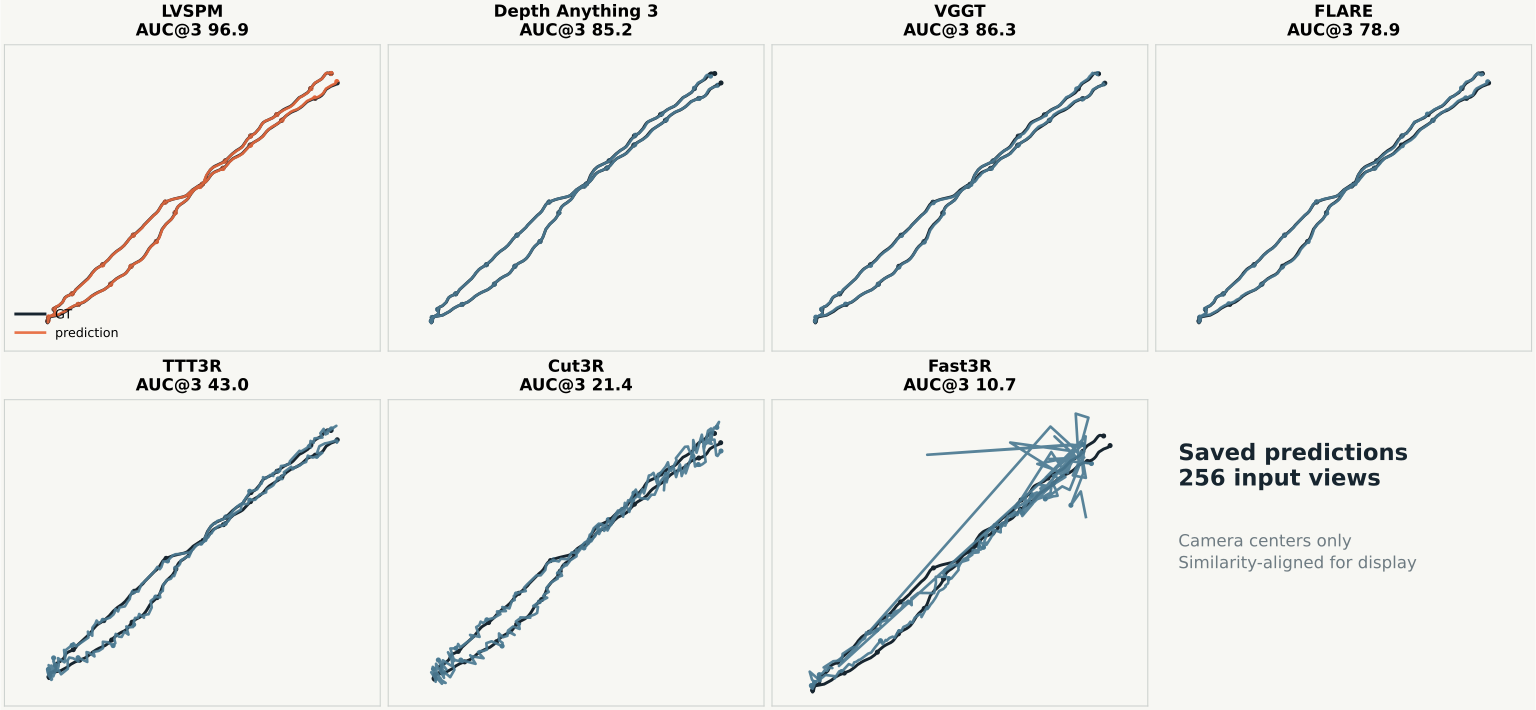
SAVED PREDICTIONS · REPRESENTATIVE 256-VIEW SCENE
Every baseline trajectory, revealed in sequence.
Scene 1881… was selected by LVSPM’s margin to the strongest baseline. Camera centers are similarity-aligned only for visualization; AUC values are the saved scene metrics.
256-VIEW POSE ENCODING
LVSPM is the fastest measured model in this set.
LVSPM1.78 s
Cut3R12.41 s
Depth Anything 316.38 s
TTT3R17.25 s
VGGT21.26 s
Fast3R21.81 s
FLARE23.13 s
13.0×faster than the slowest measured baseline58.8 FPSnovel-view rendering after encoding
Encoder-time fields from the saved 256-view output summaries; LVSPM uses the canonical paper/release measurement.
ABLATION · WHAT ACTUALLY MATTERS
Joint RGB supervision and long-context capacity both matter.
camera prediction↔novel-view prediction
Rendering supplies dense geometric evidence without depth or point-map labels.
Setting
AUC@3 ↑
PSNR ↑
SSIM ↑
LPIPS ↓
DL3DV · 32 views
without synthetic pretraining
79.9
20.08
.589
.267
LVSPM
80.2
21.12
.638
.222
ASE · 32 views
without RGB loss
50.9
—
—
—
half TTT chunk
67.9
24.98
.702
.263
12 TTT layers
59.3
24.18
.673
.288
LVSPM full
71.9
25.01
.701
.257
Remaining limitsfine structurereflectionsweak texturemulti-stage training
TAKEAWAYS
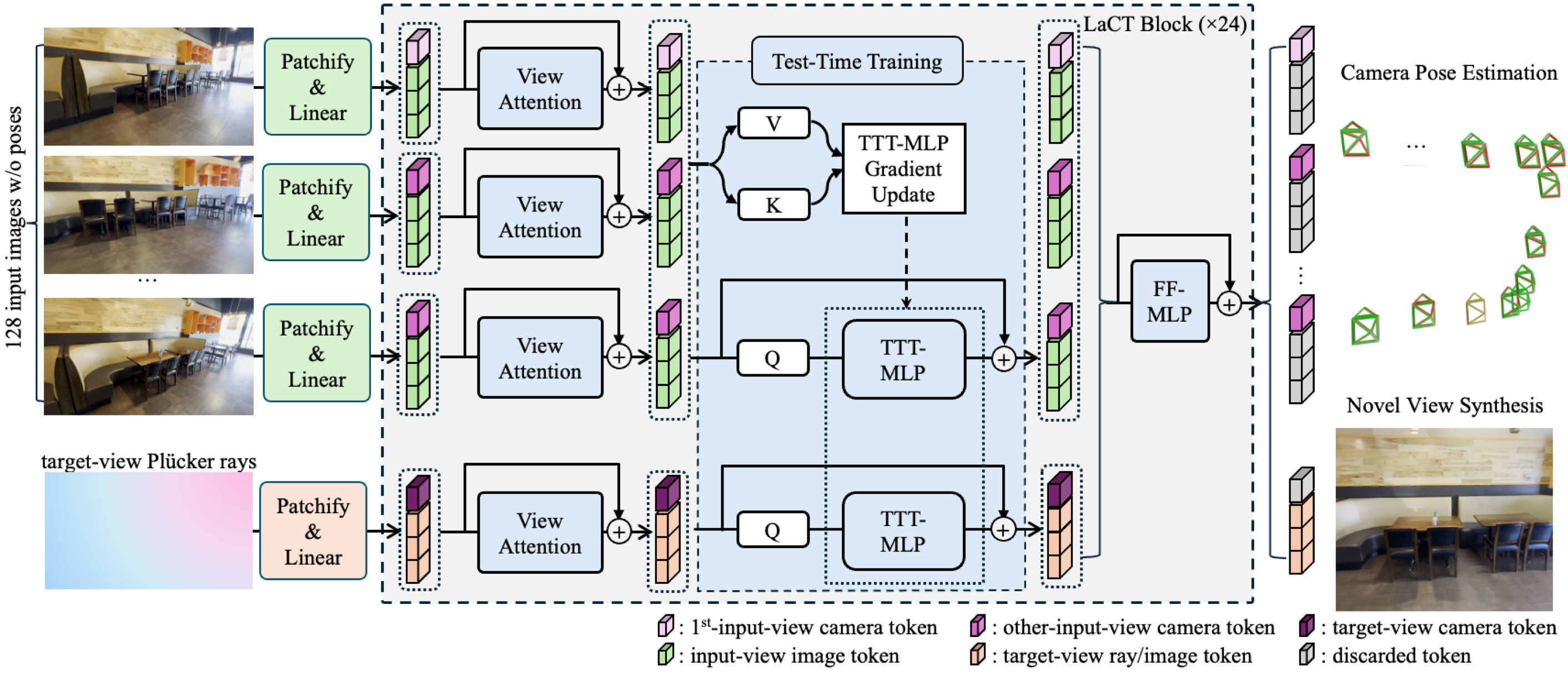
Long-sequence, pose-free view synthesis in one model.
01
Unified output camera poses and target RGB
02
Long context directly evaluated to 256 views
03
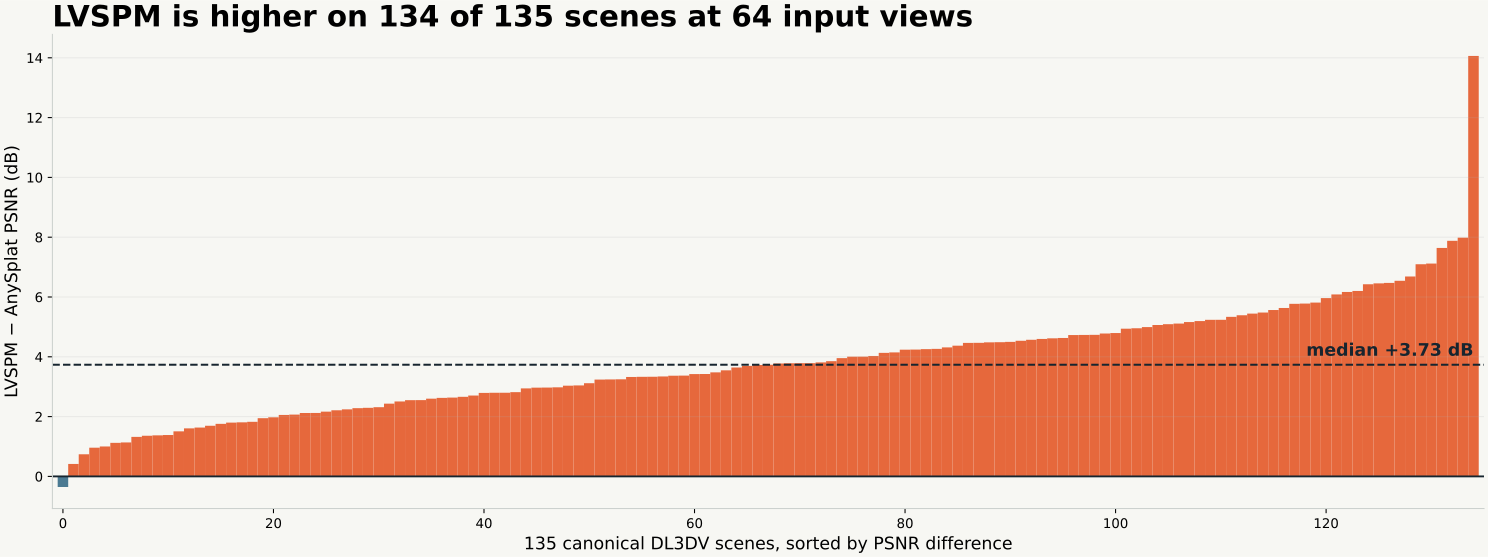
Measured impact stronger NVS, pose, and speed
All comparisons in this deck come from canonical saved outputs or documented release measurements.